Historical Hats, Costumes & Accessories |
||
|
Home Crown Hood and Liripipe Man´s Cap Chaperon Torque Bycocket Crispinette Tressour Crispinette Nebule Templars Cross Tree Headdress Heart Shaped Hennin Attor de Gibet Jewelled Coif Hennin Flowerpot Hennin Halo Bonnet Reticulated Caul Flemish Hood Early Gable Headdress Tudor/Elizabethan Pouch Gloves Wedding Dresses Specialist Commissions Kats Kittens Authentic Effigy Based Headwear Miscellaneous Contact Links |
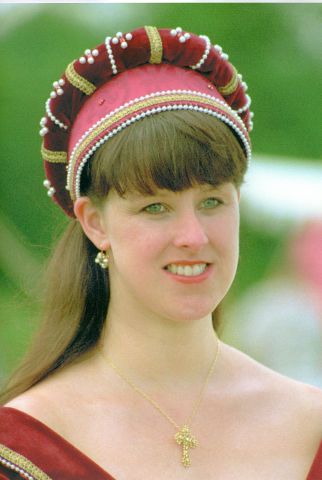
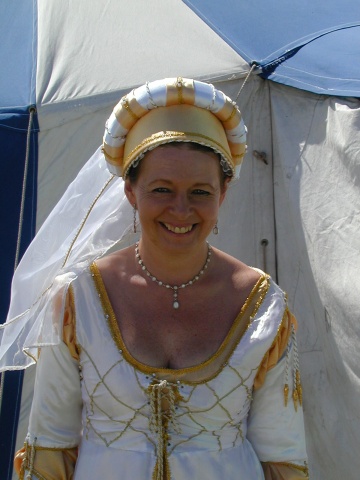
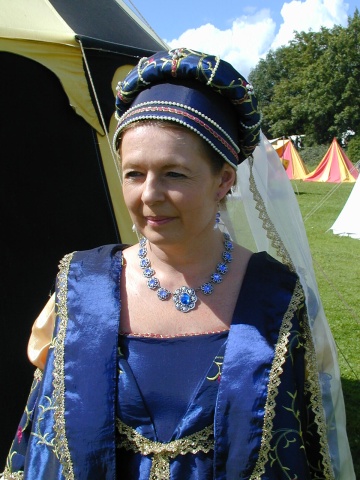
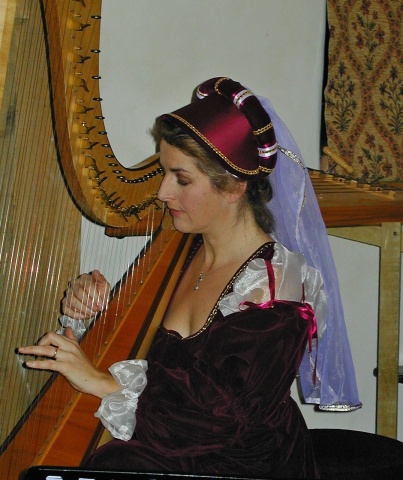
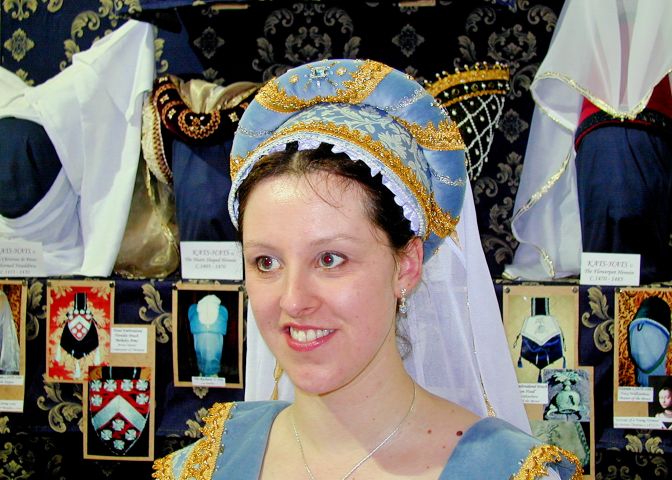
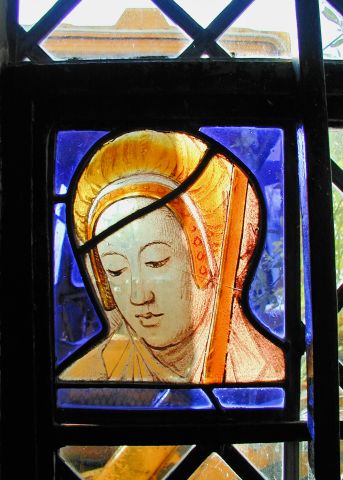
The Flemish Hood approx c. 1453 - 1510 The turban effect came into vogue after the fall of Constantinople in 1453. Roundlets were stuffed and padded with Tow or Horsehair, covered in brilliant coloured fabrics "Gold Tissue" and heavily jewelled. Veils were worn with the Flemish Hood "falling gracefully down the back" as well as sometimes being arranged to fall over the forehead and to the eyes, tied tightly over the whole Headdress or even worn without a veil at all. The Flemish Hood was worn by all levels of society, from High ranking Nobles to the Lower classes. Most representations of this headdress in England and France can be found in paintings (by Dürer) and tapestries by Flemish artists. One such tapestry is at Hardwick Hall, Derbyshire and another is of an image of a Lady in a Flemish Hood which can be seen in stained glass window at Weycroft Manor, a Tudor House near Axminster, North Devon. The Flemish Hood was worn throughout Flanders, Germany, The Netherlands, England (adopted occasionally), France and Italy where the Headdress was enlarged and deformed in such a way only the Italians, who were the forerunners in Fashion (Closely followed by France), would do and still be considered "Stylish." These Italian Hoods became so exaggerated and bulbous until becoming very much enlarged at the back of the head. A contempory quote says "No amount of Decoration could make it becoming." In The Netherlands natural hair would be "wound round the head" over the Cap instead of the Jewelled Roundlet. This style was favoured by young girls and young women from both Upper and Lower classes. German women, unlike other women of Western Europe, allowed their coiled or ringleted hair to show at the sides of their version of the Flemish Hood, Caps or other fashionable headwear. The Lower classes covered their Caps and Roundlets in coarse linen. From 1510 onwards the Flemish Hood was still worn alongside the Famous Gable Hood, but other Tudor styles of headwear became dominant throughout Europe, and the Flemish Hood was slowly phased out.
Headdress Design © 2001 - 2011|Site Design © 2005, 2006, 2007, 2008, 2009, 2010, 2011, 2012, 2013 All Items produced by Kats Hats © are subject to full copyright and may not be reproduced under any circumstances. Individuals have my permission to print single copies of the pictures or texts on this website for research for non-commercial purposes and private study provided Kats Hats © name, the copyright notice and this permission notice are preserved on all copies. Linking to this site is allowed without permission. For any other use please contact me. | |
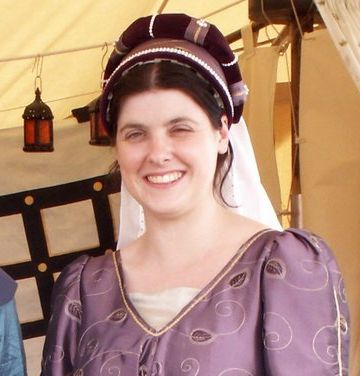 This style of headdress, sometimes also called a